
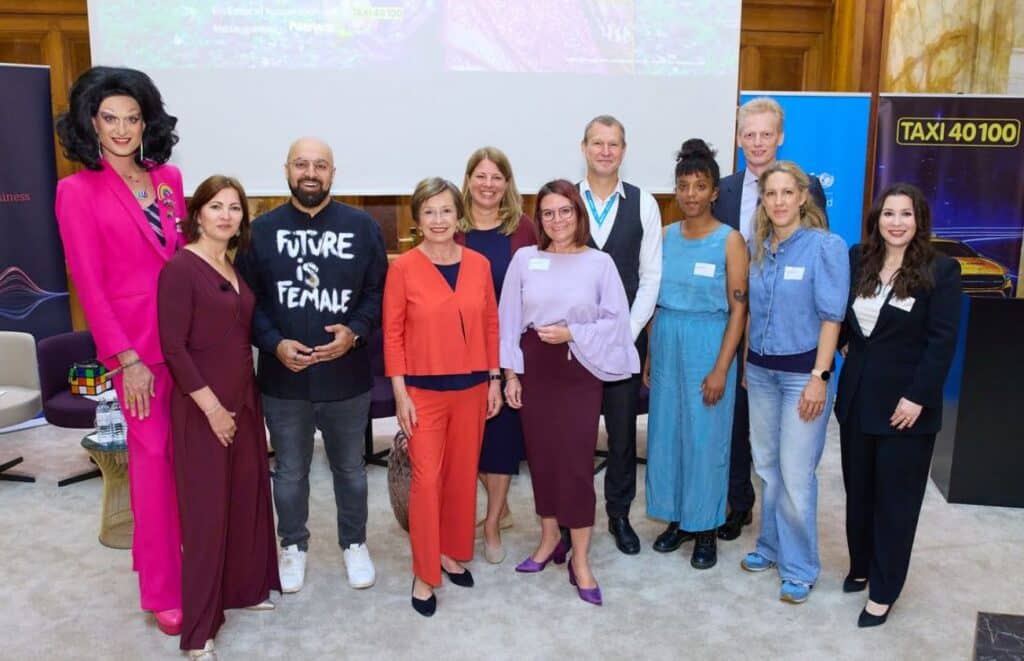
UNICEF Austria round table with Guest of Honour Doris Schmidauer on AI and women’s rights
Vienna, June 3, 2026 – Digitalization and AI are fundamentally changing our world.
What impact does this rapid technological progress have on young girls and women? What can companies actively do to help relieve employees’ fears of impending job losses? What is the Oky app, and why is it so important for girls and for children’s right to diversity? All these questions and many
more were discussed on June 3 as part of a round table on “Girls’ and Women’s Rights in the Age of AI and Digitalization” at the Oktagon at DLA Piper in Vienna.
UNICEF Austria, NEWS, and Taxi 40100 jointly brought together a special panel with high-profile guests from various fields. The opening keynote was delivered by Doris Schmidauer, First Lady and First Volunteer, followed by the presentation of the highly innovative and
inclusive Oky App by Gerda Binder from UNICEF. The panel discussion featured:
Elisabeth Dal Bianco (IKEA Austria), Nicole Daniel (DLA Piper), Candy Licious (drag queen artist), Ali Mahlodji (Business Humanist & Leadership Mentor), Martina Romero (social scientist), and Carina Zehetmaier
(Women in AI). Eveline Hruza, Secretary General of Taxi 40100, was responsible for moderation and storytelling.
All panelists agreed: AI systems are not neutral but reflect societal power structures. Biases that we program into the digital world influence girls
and women more long-term than we believe. At the same time, digitalization and AI open up new professional fields, and applications like UNICEF’s Oky App can make a significant contribution to
supporting the rights of young women on their developmental journey.
Selected statements from the panelists: Doris Schmidauer, First Lady and First Volunteer: “I am convinced that we should view artificial intelligence primarily as an opportunity and possibility—perhaps even as a kind of new right to access knowledge, support, and participation. It should not be perceived as an obligation or compulsion, but as a tool that people can use voluntarily to enrich their lives, their work, and their
education.
My vision is a society in which AI helps to reduce existing inequalities rather than reinforce them. Used correctly, it can open up new opportunities for people regardless of their background, income, or
educational path. It can make knowledge more accessible, provide individual support, and help break down barriers that have previously excluded many people from opportunities and participation.”
Gerda Binder, UNICEF & Oky App “Oky shows me how good digitalization can be when we truly listen to girls and let them help shape it. An app has emerged from their needs that imparts knowledge, strengthens self-confidence, and breaks taboos. Digital participation is not a luxury, but a right. If we consciously design technology to be inclusive, it can empower girls everywhere in the world. That is exactly what we experience every day with Oky.”
Elisabeth Dal Bianco, IKEA Austria:
“That more than half of our managers at IKEA Austria are women today is no coincidence—it is the result of consistent effort. We need that same consistency now in how we deal with artificial intelligence: we must ensure that AI systems promote equal opportunities and do not
reproduce existing inequalities. Because in the end, it is not the technology that bears responsibility—it is we humans. And that starts with the right mindset and a clear values culture within the company.”
Nicole Daniel, Partner at DLA Piper: “More far-reaching standards are needed to comply with the prohibition of AI discrimination. Existing anti-discrimination laws generally also apply to AI systems, but they were not developed for algorithmic systems. The EU AI Act creates an important regulatory framework to identify and limit discrimination—including
gender-based disadvantages—at an earlier stage. However, what will be decisive is how effectively these requirements are implemented and monitored in practice.”
CandyLicious, Drag Queen Artist:
“And when it comes to online hate, we must finally speak honestly about the fact that no one should have to manage this alone. Self-care, a strong awareness of one’s own mental health, friends,
family, and professional counseling are essential. Personally, I would not have made it through many situations if I had been alone. That is why we need not only technical solutions against hate speech, but also genuine social responsibility and solidarity.”
Eveline Hruza, presenter and storyteller, Taxi 40100:
“For me, Taxi 40100 is a perfect example of how digitalization works: In the past, people called a horse-drawn carriage; today, you can simply order an e-taxi via app. From market studies, we know that 80 percent of Gen Z order their taxi via app. This evolution clearly shows the potential of digitalization – it makes things simpler, faster, more accessible. Digitalization and AI can be designed in such a way that they truly empower girls and women.”
Ali Mahlodji:
“I once taught my daughters that they can use a knife to spread butter on bread, or, if they are not careful, hurt each other. The same applies to digital tools and who controls them. We are currently at a crossroads where we must be careful not to transfer the prejudices
of our broader society, especially toward women, into the digital world as well. We are all called upon here. The moment a person enters the digital world, a world of curiosity opens up. But there is a difference between whether it becomes a Pandora’s box or a place where we can learn. We must shape this digital world thoughtfully, because the prejudices we program into it influence people more long-term than we believe.”
Martina Romero, social scientist:
“Feminist AI means not viewing technology as neutral, but as an expression of societal power relations. From an intersectional perspective, AI must be designed so that it does not reproduce existing exclusions and discrimination, but instead makes diversity visible,
strengthens participation, and opens up fairer societal future possibilities.”
Carina Zehetmaier, President of Women in AI “Artificial intelligence is never neutral—it learns from our data and reflects our society, with all its biases. If women and girls do not help shape it, we will cement existing inequalities in tomorrow’s code. Diversity is therefore
not a nice-to-have, but a prerequisite for fair and trustworthy AI systems.” The future does not just happen—we shape it, and the decisions about what our tomorrow looks like are made today. Those who build AI shape society. This responsibility must not be left to a small, homogeneous group.”
Together, we are shaping a fairer and more inclusive digital future.
Diversity, inclusion, and equal opportunity are not just buzzwords—they are non-negotiable rights that every child worldwide deserves. Together with its partners, UNICEF Austria calls for taking a stand and visibly advocating for the rights of disadvantaged girls and women. These values are lived 365 days a year alongside strong partners.
By the way: This press release was written by two women, with an AI as a sounding board.
Inquiry Notice
Taxi 40100:
Mag. Eveline Hruza, e.hruza@taxi40100.at, +43 676 879910854
UNICEF Austria:
Mag. Lisa Heidegger-Haber, MA, presse@unicef.at, +43 660 34 83 653
Taxi 40100
is the ride service provider with the most extensive experience in Austria. Successfully on the market for over 50 years, Taxi
40100 dispatches fleets in Vienna (over 1,800 vehicles), Linz (Taxi 2244), Salzburg (Taxi 2220), Wels, Villach, Eisenstadt, and in many other
municipalities. In Linz and the surrounding municipalities, the most successful Shared Call-Taxi System (AST) in Europe has been in use for many years in cooperation with Linz AG—a sensible and environmentally friendly form of modern mobility.
You can order a taxi from Taxi 40100 via telephone, smartphone app, or internet portal; in all vehicles, you can pay cashless
(debit, credit, corporate cards, vouchers) and, of course, in cash. With Taxi 40100, customers are always a step
ahead: 98% of all calls are answered within 15 seconds. And over 90% of our customers receive their
ordered taxi within 5 minutes.
UNICEF
UNICEF, the United Nations Children’s Fund, advocates for the rights of every child worldwide, especially the most
disadvantaged children and in the hardest-to-reach places. In more than 190 countries and territories, we do
everything necessary to help children survive, develop to their full potential, and realize their possibilities. UNICEF is represented in Austria by the Austrian Committee for UNICEF. Since 1962, UNICEF Austria has been working for children—both abroad and at home. UNICEF’s work is funded exclusively by voluntary contributions. To be able to continue our work, we urgently need your support.
Rückfragen & Kontakt:
Taxi 40100
Mag. Eveline Hruza
Generalsekretärin
Pfarrgasse 54, 1230 Wien
e.hruza@taxi40100.at